

Free cooling provides significant opportunities to generate energy savings. It can take effect when the difference between the outside supply and return temperatures is as little as 1°C. This means that, in a 24/7 data centre with a typical room temperature of 24°C, over 95% of the year can be spent with free-cooling active.
In addition to energy savings through reducing the need for mechanical (DX) cooling, concurrent free-cooling also maximises the part-load efficiencies of components such as EC fans, inverter-driven pumps and centrifugal compressors. The variable speed control on such components allows load to be very precisely matched to cooling duty, reducing energy consumption and unnecessary wear. EC fans for example are up to 70% more efficient than AC fans at part-load.
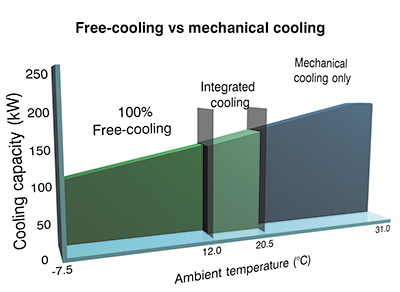
The use of temperature sensors and sequencer controls allows for cooling to be staged, ensuring a smooth transition from mechanical cooling to air free cooling.
On sites with an air cooled and free cooling chiller, the sequencer ensures that when the ambient is low, the free cooling chiller is the first to start up.